


Walker-Warburg Syndrome (WWS) Screening


Walker-Warburg syndrome (WWS) is a rare inherited condition that affects the development of the muscles, brain, and eyes.¹ It's the most severe of several conditions linked to the FKTN gene.² About 1 in 80 people of Ashkenazi Jewish descent carry a mutation in FKTN.² Carriers don't typically have any symptoms, so many people don't realize they could pass the condition on to a child.² Reproductive carrier screening that includes the FTKN gene, looks for mutations that can cause Walker-Warburg syndrome and can help you know your risk before pregnancy.
What is Walker-Warburg Syndrome?
Walker-Warburg syndrome belongs to a group of more than 30 genetic muscle conditions, called congenital muscular dystrophies, that cause low muscle tone and weakness at birth or during infancy.¹ Symptoms of WWS are present at birth and affect three main areas:¹
- Muscles: very low muscle tone and weakness that typically get worse over time¹
- Brain: serious differences in brain development, usually including a smooth brain surface without its normal folds and a buildup of fluid in the brain¹
- Eyes: a wide range of eye differences, most of which lead to partial or complete blindness¹
Together, these brain and muscle differences cause significant delays in milestones like sitting up, grabbing objects, crawling, and talking.¹ They can also make breathing and swallowing difficult.¹ Many babies with WWS pass away in infancy, and most affected children do not survive past age three.¹
There is currently no cure for WWS.¹ Care is symptom-based and may include seizure medication, surgery to drain extra fluid from the brain, physical therapy, and feeding support.¹,²
FKTN
FKTN is a gene associated with Walker-Warburg syndrome. It is involved in muscle stability and helps nerve cells move into the correct place as the brain develops.¹ The brain, eyes, and certain muscles do not function correctly when there are mutations in FTKN. These mutations can cause symptoms that range in severity and vary widely, even within the same family.² Of these FKTN-related conditions, WWS is the most severe.²
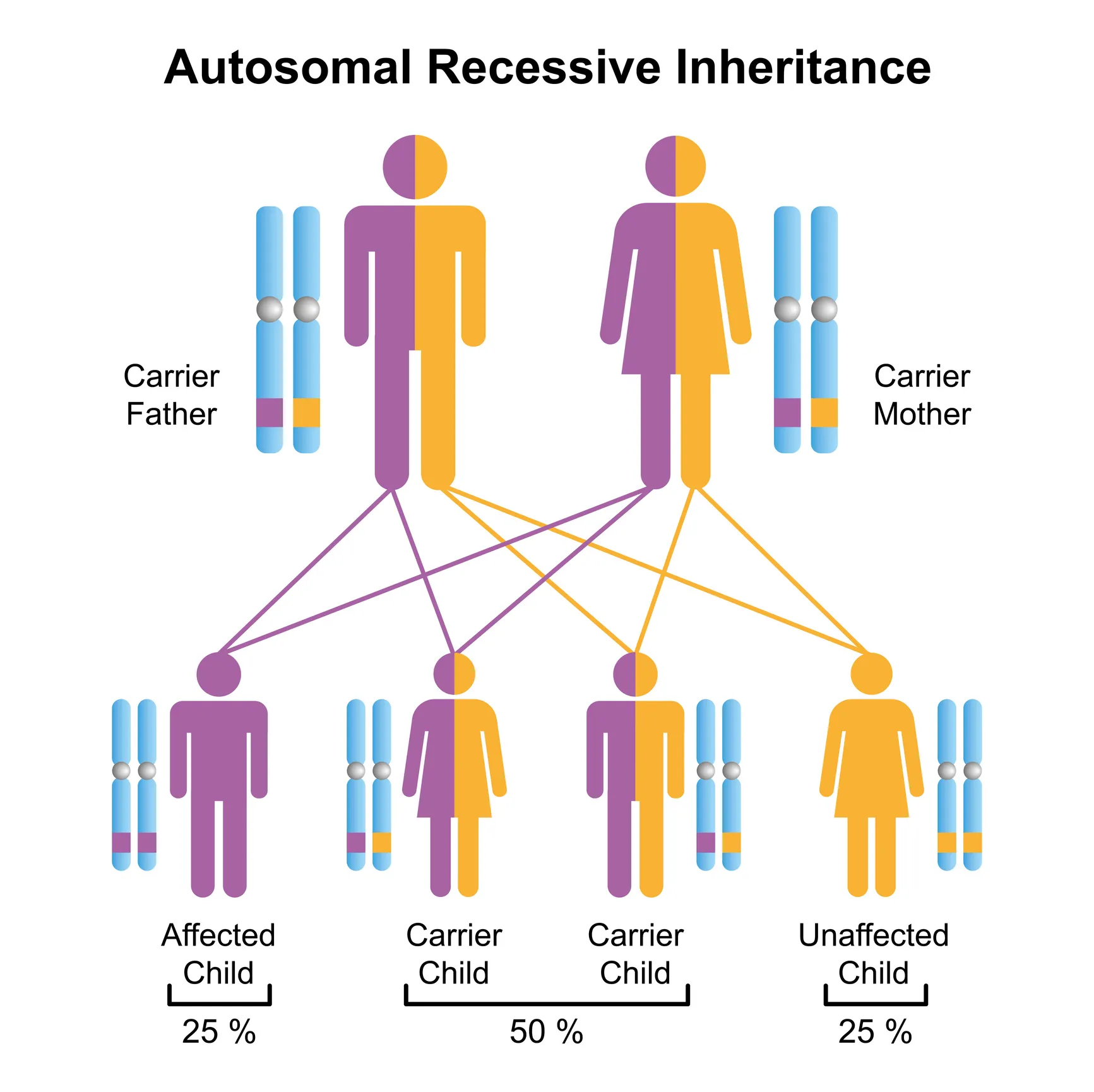
Walker-Walberg syndrome is inherited in an autosomal recessive pattern.¹ This means a child has to inherit a non-working copy of the gene from each parent to be affected.¹ Someone with one working copy and one non-working copy is a carrier and usually has no symptoms.¹
If both parents are carriers, each pregnancy has:
- A 25% chance the child inherits a non-working copy from each parent and is affected with WWS
- A 50% chance the child is a carrier, like the parents
- A 25% chance the child inherits two working copies and is unaffected and is not a carrier
Why Walker-Warburg Syndrome Carrier Screening Matters
Carriers of FKTN-related conditions typically don't have any symptoms, so there's no visible clue that you could pass a FKTN gene mutation on to a child.² Some of the brain differences linked to WWS can be seen on ultrasound or fetal MRI, but usually not until the later stages of pregnancy.¹ Carrier screening gives you information before conceiving, when you have the most time and the widest range of reproductive options.
Screening for FKTN-related conditions is recommended by the American College of Medical Genetics and Genomics (ACMG), ideally before pregnancy.3
Your Odds of Carrying a FKTN Gene Change
Your chance of being a carrier depends on your ancestry.² For people of Ashkenazi Jewish descent, the chance of carrying a change in the FKTN gene is about 1 in 80.² Across all populations, WWS is rare.¹ Because carriers usually have no symptoms, carrier screening is the only way to proactively know your risk.
Who Should Consider Screening
Carrier screening for Walker-Warburg syndrome screening is especially important to consider in a few situations:
Ashkenazi Jewish Ancestry
About 1 in 80 people of Ashkenazi Jewish descent carry a change in the FKTN gene, so your heritage alone can be a good reason to screen, even with no family history of the condition.² It's one of several Ashkenazi Jewish genetic diseases included in carrier screening.
Planning a Pregnancy
Signs of WWS often can't be seen on imaging until late in pregnancy.¹ Screening before you conceive lets you and your partner understand your risk early and talk through your options with a genetic counselor. Learn more about why screening before pregnancy matters.
A Partner who Carries a FKTN Gene Change
A child can be affected when both biological parents are carriers and each passes on a non-working copy of the FKTN gene.¹ If your partner has already screened positive, your own result is critical for understanding the risk for your future children.
Using a Sperm or Egg Donor
Reproductive carrier screening is still recommended when using an egg donor or a sperm donor to plan your family.
A Relative With a Muscular Dystrophy Diagnosis
If Walker-Warburg syndrome or another FKTN-related condition runs in your family, your chance of being a carrier may be higher than average. If a relative has been diagnosed with muscular dystrophy, especially one without a confirmed genetic cause, it's worth mentioning to a genetic counselor.
How At-Home Genetic Testing Works

Order and register

Collect your sample

Return your sample

Get your results

Talk to a genetic counselor
Costs and Insurance Coverage
Insurance Billing
Self-Pay Option
Understanding Your Results
Positive (Carrier)

A positive result means that you are a carrier and have one working copy and one non-working copy of the FTKN gene. Carriers do not have the condition, but there is a chance of having a child affected with WWS if your partner is also a carrier. While most individuals who are carriers do not show signs or symptoms, there may be risks to their health. If you are planning a pregnancy, your partner should be screened too.
Negative Result

A negative result means that no mutation was detected in the FTKN gene, and you are unlikely to be a carrier for Walker-Warburg syndrome. You should speak with a genetic counselor to ensure that you understand your risk and the risk to your children.
If You and Your Partner are Both Carriers
If you and your partner both carry a change in the FKTN gene, each pregnancy has a 25% chance of being affected with Walker-Warburg syndrome.¹ Genetic counseling is strongly recommended for carrier couples, and every jscreen result comes with access to a board certified genetic counselor who can walk you through what your results mean and what your options are.
Know Your Risk Ahead of Time
Frequently Asked Questions
Can You Be a Walker-Warburg Syndrome Carrier Without Knowing It?
Yes. Since carriers typically don't have any symptoms, carrier screening is the only way to find out whether you have a change in theFKTN gene.² For people of Ashkenazi Jewish descent, the chance of being a carrier is about 1 in 80.² For a full walkthrough of the screening process, see our complete guide to carrier screening.
What is the FKTN Gene?
FKTN carries instructions for making a protein called fukutin, which is involved in muscle and brain development. ¹ Changes in FKTN can cause several related conditions, but WWS is the most severe.²
Can Walker-Warburg Syndrome Be Seen on an Ultrasound?
Sometimes some of the brain differences linked to WWS can be seen on a routine ultrasound or fetal MRI during the late stages of pregnancy.¹ Carrier screening completed prior to pregnancy provides you with the widest range of reproductive options.
How is Walker-Warburg Syndrome Diagnosed?
After birth, doctors typically complete a clinical exam, which can include an eye exam, brain imaging, and a blood test to look for muscle damage.¹ Genetic testing can often help to confirm the diagnosis.¹
What is the Life Expectancy for Walker-Warburg Syndrome?
Because of the serious brain and muscle differences, life expectancy is reduced. Many babies with WWS pass away in infancy, and most children don’t survive past age three.¹
References
- Walker Warburg Syndrome. National Organization for Rare Disorders (NORD). Last updated April 1, 2022. Accessed October 12, 2026.
https://rarediseases.org/rare-diseases/walker-warburg-syndrome/ - FKTN-Related Disorders. Norton & Elaine Sarnoff Center for Jewish Genetics. Revised October 2023. Accessed October 12, 2026. https://www.jewishgenetics.org/genetic-disorders/search-genetic-disorders/muscular-dystrophy-dystroglycanopathy-fktn-related/
- Gregg AR, Aarabi M, Klugman S, et al. Screening for autosomal recessive and X-linked conditions during pregnancy and preconception: a practice resource of the American College of Medical Genetics and Genomics (ACMG). Genet Med. 2021;23(10):1793-1806.
https://pmc.ncbi.nlm.nih.gov/articles/PMC8488021/ - Chorionic Villus Sampling for Prenatal Diagnosis. Cleveland Clinic. Last updated August 8, 2024. Accessed October 12, 2026.
https://my.clevelandclinic.org/health/diagnostics/4028-chorionic-villus-sampling-for-prenatal-diagnosis