


Joubert Syndrome 2 (JBTS2) Screening


Joubert syndrome 2 (JBTS2), sometimes called Joubert syndrome type 2, is a rare inherited condition that affects how the brain, kidneys, and eyes develop. It’s caused by changes in the TMEM216 gene. Carriers have no symptoms themselves, so most people don’t know they're at risk until a child is affected. Carrier screening for Joubert syndrome 2 checks for the gene mutation ahead of time, so you can understand your risk before pregnancy.

What Is Joubert Syndrome 2?
Joubert syndrome 2, or JBTS2, belongs to a group of conditions called ciliopathies. These conditions are caused by problems with cilia, tiny hairlike structures on the surface of nearly every cell that help guide how the brain and other organs develop. A key sign of Joubert Syndrome 2 is a distinctive pattern on a brain MRI called the molar tooth sign. It’s formed by an unusually deep groove near the brainstem along with thickened, straightened structures connected to the cerebellum, which together, look like the cross section of a molar tooth.¹ This sign strongly suggests JBTS2, but it can also appear in other conditions, so it isn’t enough on its own to confirm a diagnosis.1
Babies with Joubert syndrome 2 often have weak muscle tone (hypotonia), unusual eye movements and irregular breathing.¹ Some also have extra fingers or toes, known as polydactyly.¹ As children grow, problems with coordination and development become more noticeable and can range from mild learning differences to significant intellectual disability.
Joubert syndrome 2 can also affect other parts of the body. Among people with JBST2:
- An estimated 23% to 38% develop kidney disease.¹
- About 30% develop retinal dystrophy, a breakdown of the retina that can affect vision.¹
- Some develop congenital hepatic fibrosis, a scarring of the liver.1
No current treatment changes the underlying course of Joubert syndrome 2. Care focuses on improving quality of life, supporting function, and reducing complications.¹ This often includes physical therapy, monitoring for kidney and liver problems, and help with breathing and feeding. Kidney disease is the leading cause of death after the first year of life, and kidney failure develops at an average age of 13.¹ Severity varies from person to person. Some features, like poor coordination, can improve with age, while others, like kidney and retinal disease, can worsen over time.¹
TMEM216
TMEM216 is one of many genes known to cause Joubert syndrome, and accounts for an estimated 2% to 5% of cases.¹ The protein it makes helps cilia form and work properly, the same process disrupted in other genetic forms of the condition.²
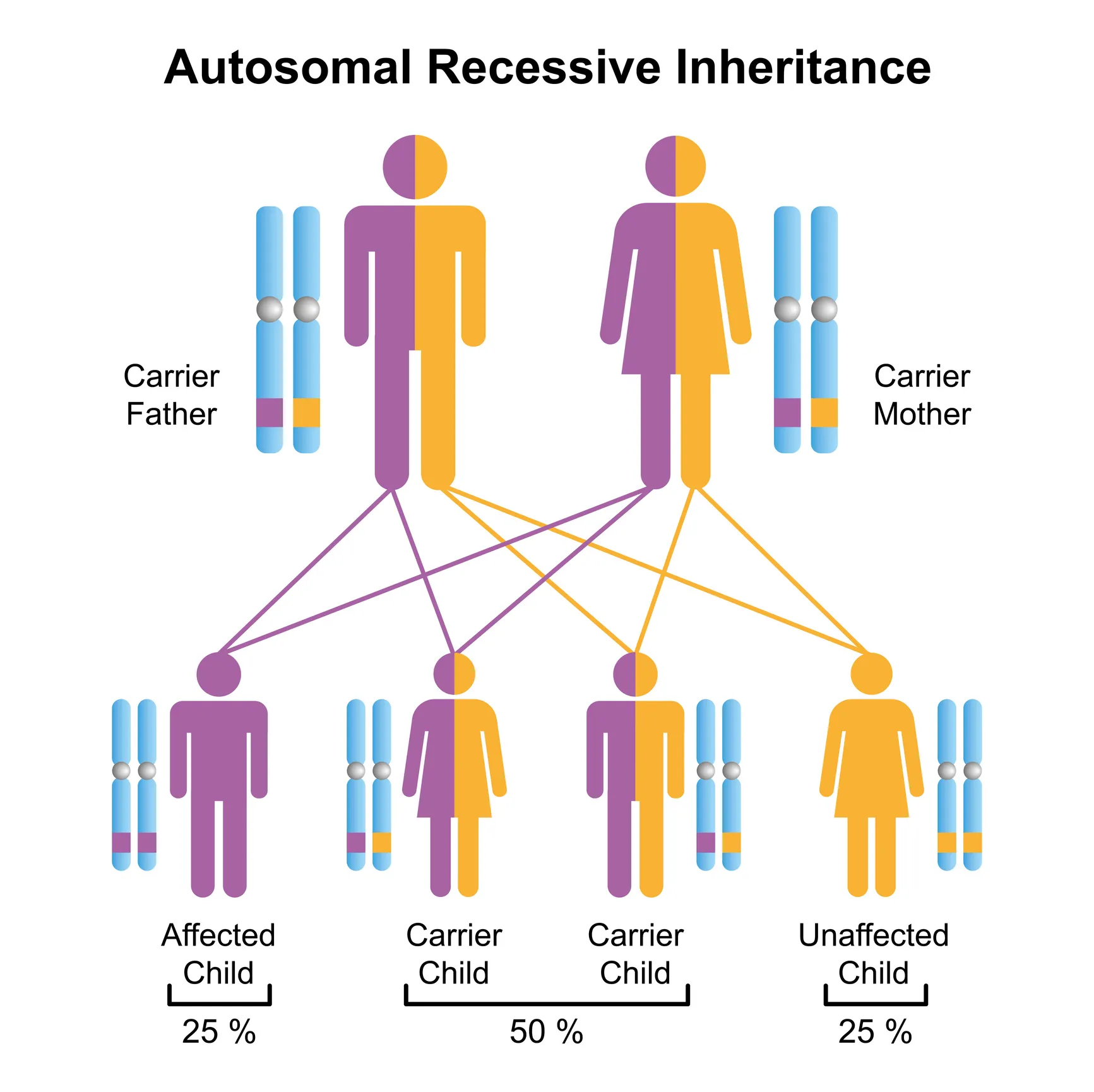
Like most genes, everyone has two copies of TMEM216, one inherited from each parent. A person with one working copy and one non-working copy is called a carrier. Carriers don’t have any symptoms, because one working copy is enough. Joubert syndrome 2 only develops when a person inherits a non-working copy from each parent.
Joubert syndrome 2 is inherited in an autosomal recessive pattern. If both parents are carriers, each pregnancy has:
- A 25% chance the child inherits a nonworking copy from each parent and is affected with Joubert syndrome 2
- A 50% chance the child is an unaffected carrier like the parents
- A 25% chance the child inherits two working copies and is not a carrier

Why Carrier Screening Matters
Carriers of Joubert syndrome type 2 have no symptoms, so screening is the only way to know your carrier status. Carrier screening before pregnancy is the most reliable way to understand your risk while you still have the most reproductive options.
Your Odds of Carrying the TMEM216 Gene Change
Joubert syndrome type 2 is one of several conditions linked to Ashkenazi Jewish ancestry. About 1 in 92 people of Ashkenazi Jewish descent are carriers.³ Outside this population, the condition is very rare and how often it occurs isn't well established.
Who Should Consider Screening
Everyone should consider carrier screening prior to pregnancy, but a few groups in particular should make Joubert syndrome type 2 screening a priority:
Ashkenazi Jewish Ancestry
The carrier rate in this population, estimated at about 1 in 92, is high enough that ancestry alone is often reason to get screened, regardless of family history.³
Planning a Pregnancy
Symptoms of Joubert syndrome type 2 appear over years rather than all at once, from early developmental delay to kidney failure that can emerge as late as the teen years. Screening before you conceive gives you the fullest picture of what a future pregnancy could mean while you still have the most options.
A Partner Who Has Already Screened Positive
If your partner has already screened positive for a change in TMEM216, you'll need to know your own carrier status to understand whether your child could be at risk.
Using a Sperm or Egg Donor
If you’re using an egg or sperm donor, their carrier status matters just as much as a partner’s would. Your child will inherit one copy of each gene from the donor, so a donor who carries a change in the same gene as you creates the same risk.
Family History of Unexplained Kidney Failure in Childhood or the Teen Years
Kidney disease in Joubert syndrome 2 can progress to kidney failure by adolescence and is the leading cause of death in affected children after their first year of life.¹ Because of this, a relative who experienced unexplained kidney failure at a young age, especially alongside developmental delay or vision differences, is worth mentioning to a genetic counselor, even if they never received a formal diagnosis.
How At-Home Genetic Testing Works

Order and register

Collect your sample

Return your sample

Get your results

Talk to a genetic counselor
Costs and Insurance Coverage
Insurance Billing
Self-Pay Option
Understanding Your Results
Positive (Carrier)

A positive result means you carry one working copy and one nonworking copy of TMEM216. You are not affected by Joubert syndrome 2 and never will be, but you can pass the nonworking copy of the gene to a child. If you're planning a pregnancy, your partner should also be screened, since your child's risk depends on whether your partner carries a mutation in the same gene.
Negative Result

A negative result means you have a significantly lower chance of being a carrier for Joubert syndrome 2. It lowers your risk significantly without bringing it all the way to zero.
If You and Your Partner Are Both Carriers
If both partners carry a change in TMEM216, each pregnancy has a 25% chance of being affected by Joubert syndrome 2. Genetic counseling is strongly recommended for carrier couples, and every jscreen result comes with access to a board-certified genetic counselor to walk through what your results mean and what your options are. If you are already pregnant, diagnostic tests such as chorionic villus sampling or amniocentesis, can determine whether the pregnancy is affected, giving you an answer before birth rather than waiting until delivery.⁴
Know Your Risk Before You're Expecting
Frequently Asked Questions
What Is Joubert Syndrome 2 Genetic Testing?
Reproductive carrier screening looks for changes in TMEM216, the gene responsible for Joubert syndrome 2. Carrier screening tells you whether you carry one copy of the disease-causing genetic mutation. Because carriers have no symptoms, carrier screening is especially useful before pregnancy.
How Does Joubert Syndrome 2 Inheritance Work?
Joubert syndrome type 2 inheritance follows an autosomal recessive pattern. This means a child needs to inherit a mutated copy of TMEM216 from both parents to be affected. When both parents are carriers, each pregnancy has:
- A 25% chance of the child being affected
- A 50% chance of the child being an unaffected carrier
- A 25% chance of the child inheriting two working copies
How Common Is Joubert Syndrome 2 Among Ashkenazi Jews?
Current estimates put the carrier rate for Joubert syndrome 2 among people of Ashkenazi Jewish descent at about 1 in 92.³
Can Joubert Syndrome 2 Cause Kidney Failure?
Yes. Kidney disease develops in an estimated 23% to 38% of people with Joubert syndrome, and it can progress to kidney failure. Kidney disease is the leading cause of death after the first year of life.¹
What Is the Life Expectancy for Someone With Joubert Syndrome 2?
Life expectancy varies and depends on which features a child develops. Some features, like poor coordination, can improve with age. Others, like kidney disease, retinal disease, and liver disease, can get worse over time and shorten life expectancy for some people.¹
Is Genetic Testing for Joubert Syndrome 2 Covered by Insurance?
Most commercial insurance plans cover genetic testing for Joubert syndrome 2 as part of a broader carrier screening panel, especially for people with Ashkenazi Jewish heritage. Your exact cost depends on your plan, deductible, and copay. Once you register, your jscreen care navigator will work with you on any questions you may have about your specific plan. Many people pay $0 out of pocket for the lab test.
Is There a Prenatal Test for Joubert Syndrome Type 2?
Yes. If you're already pregnant and both partners are found to be carriers, diagnostic testing such as chorionic villus sampling or amniocentesis can determine whether the pregnancy is affected.⁴
References
- Glass IA, Dempsey JC, Parisi M, Doherty D. Joubert Syndrome. GeneReviews. University of Washington, Seattle. Initial posting July 9, 2003. Updated February 12, 2026. Accessed September 23, 2026.
https://www.ncbi.nlm.nih.gov/books/NBK1325/ - Valente EM, Logan CV, Mougou-Zerelli S, et al. Mutations in TMEM216 perturb ciliogenesis and cause Joubert, Meckel and related syndromes. Nat Genet. 2010;42(7):619-625. Accessed September 23, 2026.
https://pmc.ncbi.nlm.nih.gov/articles/PMC2894012/ - Joubert Syndrome 2. Norton & Elaine Sarnoff Center for Jewish Genetics. Revised October 30, 2023. Accessed September 23, 2026
https://www.jewishgenetics.org/genetic-disorders/search-genetic-disorders/joubert-syndrome-2/ - Chorionic Villus Sampling (CVS). Cleveland Clinic. Last reviewed August 8, 2024. Accessed September 23, 2026
https://my.clevelandclinic.org/health/diagnostics/4028-chorionic-villus-sampling-for-prenatal-diagnosis