



Genetic Testing for Canavan Disease (CD)


Canavan disease, also called Canavan-Van Bogaert-Bertrand disease, is a rare, inherited condition that keeps the brain from properly building and maintaining the protective coating around nerve cells. This leads to severe, lifelong disability starting in early infancy. For people of Ashkenazi Jewish descent, the odds of carrying the ASPA genetic mutation associated with Canavan disease are much higher than in the general population. Carriers have no symptoms themselves, so most people don’t know they're at risk until they have an affected child. A carrier screen for Canavan disease checks for that genetic mutation so you can know your reproductive risk before pregnancy.

What Is Canavan Disease?
Canavan disease occurs when the body can't make enough of an enzyme called aspartoacylase, which normally breaks down a natural brain chemical called N-acetylaspartic acid, or NAA. Without enough of this enzyme, NAA builds up and interferes with the brain's ability to form and maintain myelin, the protective coating that lets nerve cells send signals properly.1
Most children, about 85 to 90 percent, have the typical form of Canavan disease. In this form, developmental delays become evident by three to five months of age, and are followed by a loss of skills the child had already gained. A smaller subset of children have a milder, atypical form of Canavan Disease, where delays usually show up sometime in the first years of life and tend to progress more slowly.1
Affected infants appear normal at birth but develop symptoms in the first months of life including: poor head control, abnormally large head (macrocephaly), severe intellectual disability, loss of motor milestones, feeding difficulties, seizures, and hypotonia followed by spasticity. Most children eventually lose the ability to sit, swallow, and interact with their environment, and as the disease advances, many require a feeding tube.1
Canavan disease also shortens life expectancy; most children with the severe neonatal/infantile form do not develop meaningful skills and do not survive past the first or second decade of life.1
Currently, there is no cure for Canavan disease. Instead, care focuses on supportive treatment, such as providing adequate nutrition and hydration, managing the risk of infections, and protecting the airway.1 Researchers are studying gene therapy in early clinical trials, but this isn't an approved treatment yet.1
ASPA
ASPA is the gene associated with Canavan disease. It provides the instructions for making aspartoacylase, the enzyme responsible for breaking down NAA. When both copies of ASPA carry a change that stops the enzyme from working, NAA builds up to harmful levels.1
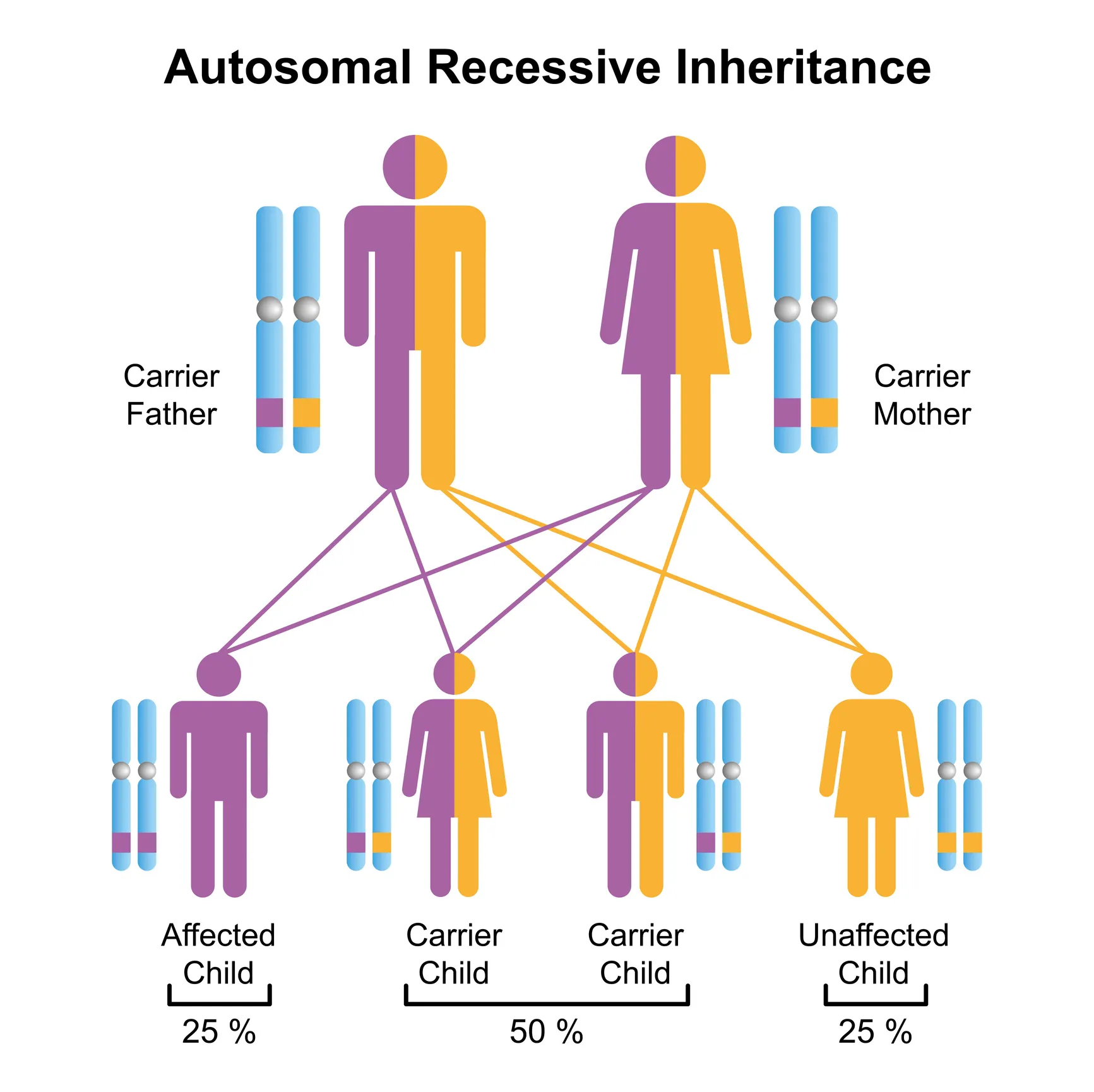
Canavan disease inheritance follows an autosomal recessive pattern. If both parents carry a change in ASPA, each pregnancy has:
- A 25% chance the child is affected with Canavan disease
- A 50% chance the child is an unaffected carrier, just like the parents
- A 25% chance the child inherits neither copy and is not a carrier
Two specific changes in the ASPA gene account for most cases in people of Ashkenazi Jewish descent. Because carrier frequency estimates depend on which of the two a given study counted, you'll sometimes see a range, from about 1 in 40 to 1 in 82, rather than one single agreed on number.1

Why Carrier Screening Matters
Carriers of Canavan disease have no symptoms. Genetic testing is the only way to know your carrier status. Family history isn't a reliable safeguard either, since many parents have no known affected relatives. Because there's currently no cure and the condition is severe starting in early infancy, carrier screening before pregnancy is the most reliable way to understand your risk while you have the most reproductive and risk-reducing options.
Your Odds of Carrying the ASPA Gene Change
Canavan Disease is one of several conditions with a much higher carrier rate among people of Ashkenazi Jewish descent, where about 1 in 40 to 1 in 82 people are carriers.1 In other populations, the carrier rate isn’t well established but is believed to be much lower.3 Even so, most new diagnoses today are in families with no known Ashkenazi Jewish ancestry.1 That’s partly because carrier screening has been common in Ashkenazi Jewish communities for decades. Carrier screening matters for everyone, not only people with Ashkenazi Jewish roots.
Who Should Get Screened for Canavan Disease
While carrier screening benefits everyone who is planning a family, Canavan disease screening is a higher priority for certain groups:
Ashkenazi Jewish Ancestry
Due to two founder mutations in the ASPA gene, the carrier rate among Ashkenazi Jews is estimated to be between 1 in 40 and 1 in 82.
Planning a Pregnancy
Because Canavan disease has no cure and causes severe functional impairment, screening before pregnancy gives you the most risk-reducing options.
A Partner Has Already Screened Positive
If your partner is a known carrier, learning your own carrier status tells you whether you’re at risk of having a child with Canavan disease.
Using a Sperm or Egg Donor
If you’re using an egg or sperm donor, their carrier status matters just as much as a partner’s would. Your child will inherit one copy of each gene from the donor, so a donor who carries a change in the same gene as you creates the same risk.
Canavan Disease in Your Immediate Family
If Canavan Disease runs in your family, you’re more likely to be a carrier, whatever your ancestry. Screening is worth considering even if you don’t have Ashkenazi Jewish heritage, because most new diagnoses today occur outside that population.
How At-Home Genetic Testing Works

Order and register

Collect your sample

Return your sample

Get your results

Talk to a genetic counselor
Costs and Insurance Coverage
Insurance Billing
Self-Pay Option
Understanding Your Results
Positive (Carrier)

A positive result means you carry one working copy and one nonworking copy of ASPA.1,2 You are not affected by Canavan disease and never will be, but you can pass the nonworking copy of the gene to a child. It is critical to have your partner tested, as the risk of having an affected child is impacted by whether they carry a change in the same gene too. This also applies if you're using a sperm or egg donor.
Negative Result

A negative result means there is no detectable mutation in your ASPA gene and that there is a very low chance of being a carrier for Canavan disease.
If You and Your Partner Are Both Carriers
If both partners carry a change in ASPA, each pregnancy has a 25% chance of being affected by Canavan disease.1,2 A genetic counselor will review your options for family planning, including prenatal testing during a pregnancy, using assisted reproductive options to help avoid having an affected child, or choosing not to have biological children together. If you are already pregnant, diagnostic tests such as chorionic villus sampling or amniocentesis can determine whether a current pregnancy is affected, giving you an answer before birth rather than waiting until delivery.4
Get Answers Before You Need Them
Frequently Asked Questions
What Is Canavan Disease Genetic Testing?
Canavan Disease genetic testing looks for variants in ASPA, the gene linked to the condition. Carrier screening for Canavan Disease tells you whether you carry a variant that could be passed on to your children. A child is affected only if both parents pass on a variant, so testing both partners gives the clearest picture.
How Does Canavan Disease Inheritance Work?
Canavan Disease is inherited in an autosomal recessive pattern. This means a child must inherit a non-working copy of the ASPA gene from both parents to be affected. When both parents are carriers, each pregnancy has:
- A 25% chance of the child having Canavan Disease
- A 50% chance of the child being an unaffected carrier
- A 25% chance of the child inheriting two working copies¹,²
What Is the Canavan Disease Carrier Rate in People with Ashkenazi Jewish Ancestry?
Current estimates put the Canavan disease carrier rate among people of Ashkenazi Jewish ancestry at about 1 in 40 to 1 in 82, depending on which of two specific gene changes a given study included.1 That's considerably higher than the carrier rate believed to exist in the general population.3
Is There a Canavan Disease Test That Can Be Done Before Pregnancy?
Carrier screening can be done before you're pregnant to learn your carrier status, while you have the most reproductive options. If you're already expecting and both partners are found to be carriers, prenatal diagnostic testing such as chorionic villus sampling or amniocentesis can determine whether the pregnancy is affected.4
Can Canavan Disease Be Cured?
Not currently. There is no cure for Canavan disease, and care focuses on supportive treatment such as nutrition, hydration, seizure management, and protecting against infection.1 Researchers are evaluating gene therapy, but it isn't yet an approved treatment.1
Is Genetic Testing for Canavan Disease Covered by Insurance?
Most commercial insurance plans cover genetic testing for Canavan disease as part of a broader carrier screening panel, especially for people with Ashkenazi Jewish ancestry. Your exact cost depends on your plan, deductible, and copay. Once you register, your jscreen care navigator will work with you on any questions you may have about your specific plan. Many people pay $0 out of pocket for the lab test.
What's the Difference Between Typical and Atypical Canavan Disease?
About 85 to 90% of children with Canavan disease have the typical form, where developmental delays appear by three to five months of age and are followed by a regression in development. The remaining 10 to 15% have a milder, atypical form, where delays usually show up later, sometime in the first years of life, and tend to progress more slowly.1
What Is the Life Expectancy for Canavan Disease?
The prognosis is poor, as Canavan disease shortens life expectancy. About 73% of individuals survive to age ten, and a minority live into adulthood.1
References
- Nagy A, Bley AE, Eichler F. Canavan Disease. GeneReviews. University of Washington, Seattle. Initial posting September 16, 1999. Updated June 23, 2026. Accessed September 11, 2026.
https://www.ncbi.nlm.nih.gov/books/NBK1234/ - Canavan Disease. Norton & Elaine Sarnoff Center for Jewish Genetics. Last updated September 7, 2023. Accessed September 11, 2026.
https://www.jewishgenetics.org/genetic-disorders/search-genetic-disorders/canavan-disease/ - Canavan Disease. National Organization for Rare Disorders (NORD). Last updated September 24, 2024. Accessed September 11, 2026.
https://rarediseases.org/rare-diseases/canavan-disease/ - Chorionic Villus Sampling (CVS). Cleveland Clinic. Last reviewed August 8, 2024. Accessed September 11, 2026.
https://my.clevelandclinic.org/health/diagnostics/4028-chorionic-villus-sampling-for-prenatal-diagnosis