

Why College Is the Ideal Window to Begin Thinking About Your Genetic Risks


Summary
- Genetic testing is for everyone: You don't need a family history of disease or symptoms to benefit. Anyone can carry hidden genetic traits regardless of age, background, or lifestyle.
- Two main types of screening:
- Reproductive Carrier Screening: Checks for 260+ conditions to help you make informed decisions before starting a family down the road.
- Hereditary Cancer Screening: Tests 60+ genes (like BRCA) to help you and your doctor take early action against elevated cancer risks.
- 100% at home & effortless: No clinics, needles, or waiting rooms. You order online, send back a simple saliva sample, and get paired with a certified genetic counselor to explain your results.
- Knowledge is power: Getting answers in your 20s lets you take control of your long-term health and future early, on your own terms.
Taking Charge of Your Health Independence
Starting college or heading out on your own is a huge milestone. You're suddenly the one in charge of your classes, your budget, and your career path. But there's another part of being an adult that's just as important: taking ownership of your health. While you're focusing on your future, it's the perfect time to think about genetic testing before pregnancy and other screenings that can help you plan for a healthy life ahead.
In the past, "staying healthy" in your 20s usually just meant getting your flu shot and going for a check-up. Today, being proactive means understanding more about your DNA. Your early adult years offer a unique chance to get these insights for a few simple reasons:1
- Thinking Ahead: Even if starting a family feels like a lifetime away, getting the facts on genetic testing before pregnancy now means you won't have to make rushed, stressful decisions later. It gives you the most options and peace of mind when you're ready.2
- Building Your Health Profile: As you move on from your pediatrician, knowing your genetic risks gives you valuable data to share with your new doctors, whether it's a primary care physician or an OB/GYN.
- Proactive Cancer Prevention: Identifying any inherited risks early lets you start screenings or preventive steps at the right age—often in your 20s or 30s—with the goal of preceding and any issues that may arise.3
Carrier Screening vs. Cancer Risk: What’s the Difference?
jscreen provides access to two types of testing: carrier screening (for future family planning) and genetic testing for cancer (provides you with information for your own long-term health).4
Understanding Carrier Screening
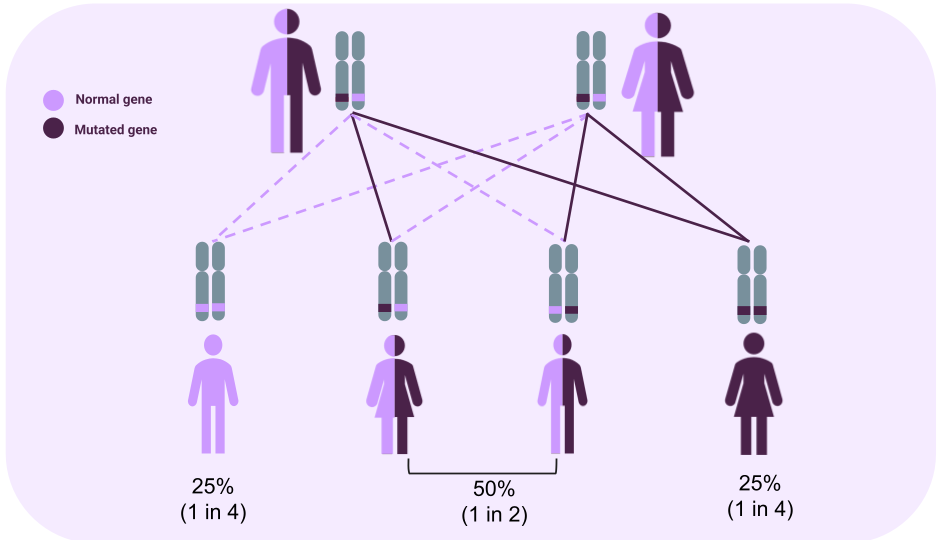
Being a "carrier" means you have one working copy and one altered copy of a gene. Carriers are typically healthy and usually have no idea they carry a mutation. Carrier screening through jscreen includes the process of identifying these hidden risks.5
If both parents are found to be carriers for the same condition, here is how the math works out for each pregnancy:
- A 25% chance of inheriting two non-working gene copies (resulting in an affected child).
- A 50% chance of inheriting one working and one non-working copy (resulting in an asymptomatic carrier, like either of the parents).
- A 25% chance of inheriting two working copies (unaffected and not a carrier).4,5
Here is the surprising part: about 80% of children born with these conditions have no family history of that condition.6 These genes can hide in families for generations. That’s why carrier screening is so important—it uncovers information that your family history often can't.
Screening is a smart choice for everyone. However, your ancestry can play a role in which risks are most common:7
- Ashkenazi Jewish Ancestry: Roughly 3 in 4 people with this background are carriers for at least one condition, such as Tay-Sachs or Canavan disease.7,8
- Testing for Everyone: Regardless of your background, everyone has baseline risks for conditions like Cystic Fibrosis or Spinal Muscular Atrophy. This is why we use expanded carrier screening panels that cover a wide range of conditions.6
Taking Control with Genetic Testing for Cancer
While carrier screening is about future children, genetic testing for cancer is mostly about you and your risks. It looks for genetic changes in genes like BRCA1 and BRCA2 that are linked to higher risks for certain cancers. Knowing this information now gives you the power to be proactive with your health planning.3,9
For example, in individuals of Ashkenazi Jewish descent, the risk of having a BRCA mutation is 1 in 40. Finding out about this during young adulthood allows you to start specialized screenings—like breast MRIs—much earlier than usual, helping to catch or prevent issues before they start.3,9
Testing That Fits Your Life (And Your Budget)
Many students worry that genetic testing is too expensive or difficult to access. The good news is that jscreen has made the process incredibly easy and affordable:
- Simple At-Home Kits: No blood draws or clinic visits required. We ship a saliva collection kit right to your door.
- Top-Tier Lab Analysis: We use the latest technology to ensure your results are accurate and medical-grade.10
- Expert Guidance: You won’t just get a confusing report. A licensed genetic counselor is always available to meet with you virtually to explain your results and help you plan your next steps.2
- Financial Accessibility: Most patients who use insurance owe nothing further after the $49 upfront fee, which covers physician order and review.
Taking the First Step
Gaining clarity on your genetic risks now is one of the best things you can do for your future. Whether you order a kit today or join a campus screening event, you’re gaining knowledge that will protect you and your family for a lifetime.
References
- National Human Genome Research Institute. Genomics and Medicine: Understanding Your Genomic Baseline. U.S. Department of Health and Human Services; 2023.
- American College of Obstetricians and Gynecologists (ACOG). Committee Opinion No. 691: Carrier Screening for Genetic Conditions. Obstet Gynecol. 2017;129(3):e35-e40. Reaffirmed 2023.
- National Comprehensive Cancer Network (NCCN). NCCN Clinical Practice Guidelines in Oncology: Genetic/Familial High-Risk Assessment: Breast, Ovarian, and Pancreatic. Version 3.2024. 2024.
- Nussbaum, R. L., McInnes, R. R., & Willard, H. F. Thompson & Thompson Genetics in Medicine. 8th ed. Elsevier; 2016.
- jscreen Clinical Editorial Board. Understanding Carrier Status: What It Means for Jewish Families. jscreen Educational Publications; 2026.
- Grody, W. W., et al. ACMG statement on expanded carrier screening for reproductive medicine. Genet Med. 2013;15(6):482-483.
- Gross, S. J., et al. Carrier screening for Ashkenazi Jewish individuals. Genet Med. 2008;10(1):54-56.
- jscreen Research Group. Ashkenazi Jewish Carrier Frequencies and Panel Design for Reproductive Screening. 2024.
- King, M. C., et al. Genomic challenges in Ashkenazi Jewish populations: BRCA1 and BRCA2 mutation frequencies and lifetime cancer risks. Science. 2003;302(5645):643-646.
- Centers for Medicare & Medicaid Services (CMS). Clinical Laboratory Improvement Amendments (CLIA) Standards and Genetic Testing Regulations; 2022.
Share this post


